Gauge R&R (Repeatability & Reproducibility) is used to evaluate the precision of the measurement system.
When we conduct measurements we are typically trying to understand the characteristics of our products – what are the average and variability of the actual products. But our measurements necessarily include a component of variation that is caused by the measurement system itself. For instance, if we are weighing 100 individual widgets, then the standard deviation we calculate is affected by both the variability of the widgets and the variability of the scale we are using and by any differences in the way the technicians place the widgets onto the scale.
The quality of the product – whether it meets the requirements of its intended use – only depends on the average and variability of the product itself. The purpose of Gauge R&R, to quantify how much of the total variability is due to the measurement system we are using.
To illustrate this point, imagine you produce 100 high-precision cylinders and you want to know how many of them have a diameter in the range 25 +/- 0.1 mm. You send these cylinders to be measured by a very professional lab and they use exacting techniques to determine that all 100 of the cylinders are within that range. You also send the same cylinders to a very amateur lab where an unqualified trainee uses uncalibrated equipment to test the cylinders. Their report tells you that only 5 of the cylinders are within 25 +/- 0.1 mm. The poor measurements of the second lab don’t change the fact that all of the cylinders are actually within their specification.
The Gauge R&R program:
- Automates the error-prone tasks of randomizing and “de-randomizing” the samples and data
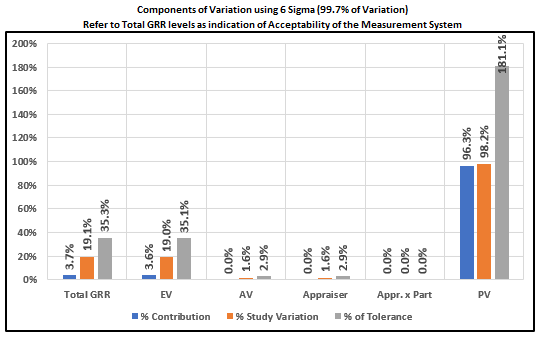
- Uses ANOVA to automatically calculate the contribution of each of the components to the Total Variation
- Calculates the Gauge R&R as a percent of the Variance, the Study Variance, and the process Tolerance
Further information on identifying and dealing with outlying replicates here
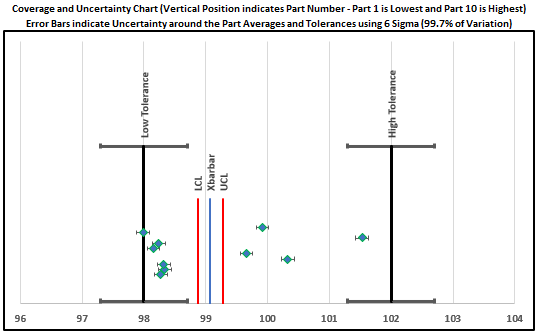
Examples of Gauge R&R charts (Components of Variation and Coverage & Uncertainty):
 Precision Scientific Software